

Property Casualty Insurance Market projected to grow from USD 3.01 billion in 2026 to USD 4.18 billion by 2035
Property Casualty Insurance Market
Property and Casualty Insurance Market Size, Share and Research Report By Insurance Type (Home Insurance, Auto Insurance, Commercial Property Insurance)
The property casualty insurance market is witnessing steady growth driven by rising asset protection needs and evolving risk management strategies.”
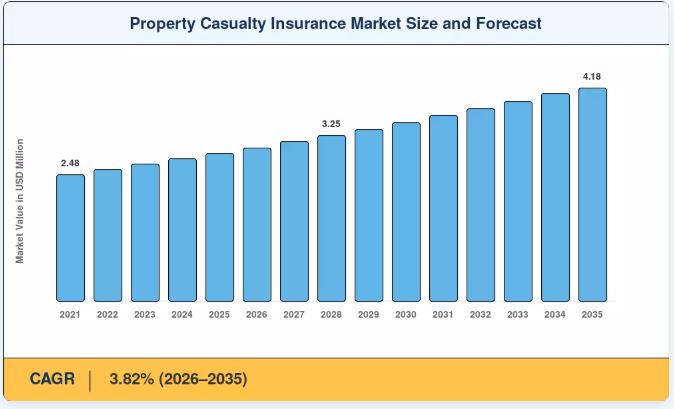
NEW YORK,, CA, UNITED STATES, June 16, 2026 /EINPresswire.com/ -- The Global property casualty insurance market reached an estimated USD 2.90 billion in 2025 and is projected to grow from USD 3.01 billion in 2026 to USD 4.18 billion by 2035, registering a CAGR of 3.82% during the forecast period. — Market Research Future (MRFR)
Two major catalysts are driving this trajectory: the accelerating frequency and severity of climate-linked catastrophic loss events which pushed global insured natural catastrophe losses above USD 130 billion in 2024 for the fifth consecutive year and the rapid adoption of AI-powered underwriting, real-time telematics, and parametric insurance structures that are enabling insurers to price risk with unprecedented granularity.
With global premium volumes exceeding USD 2 trillion annually, property casualty insurance stands as one of the world’s largest financial services markets, undergoing a profound structural transformation driven by data, technology, and climate risk repricing.
Legacy actuarial models and manual underwriting workflows are giving way to InsurTech-powered platforms that integrate satellite imagery, IoT sensor data, machine learning loss prediction engines, and real-time claims automation. A recent McKinsey analysis estimated that leading P&C carriers deploying AI-driven underwriting models achieved 15–20% improvements in combined ratios compared with peers relying on traditional pricing methodologies. This transformation is not incremental it reflects a fundamental re-architecture of how property and casualty risk is assessed, priced, distributed, and managed across personal lines, commercial lines, and specialty insurance segments.
Get Full PDF Sample Copy of Report: (Including Full TOC, List of Tables & Figures, Chart) @
https://www.marketresearchfuture.com/sample_request/33407
➤How Significant Is the Property Casualty Insurance Market’s Growth?
The property casualty insurance market has demonstrated resilient and sustained expansion, rising from approximately USD 1,742.3 billion in 2021 to an estimated USD 2,187.6 billion in 2025, reflecting a robust historical growth trajectory underpinned by rising asset values, expanding commercial insurance demand, and broadening insurance penetration across emerging economies.
The market is projected to add nearly USD 1.7 trillion in premium volume over the next decade, propelled by climate-driven demand for property coverage, rapid growth in cyber liability and technology errors & omissions lines, and the expanding insurability of previously uninsurable risks through parametric and index-linked structures.
Rising replacement costs driven by construction material inflation, supply chain disruption, and skilled labor shortages have structurally elevated property insurance premiums across residential, commercial, and industrial segments. Meanwhile, the explosive growth of digital assets, cloud infrastructure dependencies, and AI-driven business processes is creating massive new demand for specialty liability and cyber insurance products. Insurers, brokers, and MGAs are all investing heavily in digital distribution, predictive analytics, and automated claims management to improve loss ratios, reduce operational costs, and deliver policyholder experiences that match the speed and simplicity expected from modern financial services platforms.
➤What Does the Future Hold for the Property Casualty Insurance Market?
Artificial intelligence and advanced analytics stand at the forefront of the market’s next growth phase. AI-driven underwriting platforms are redefining risk assessment from a document-intensive, retrospective process into a real-time, forward-looking risk intelligence model. Machine learning algorithms now ingest geospatial data, satellite imagery, building permit histories, wildfire fuel load assessments, and social media signals to generate dynamic, property-level risk scores — enabling carriers to identify risk concentrations, optimize portfolio construction, and price policies with a level of precision unattainable through traditional actuarial methods.
Climate risk repricing is another defining structural force shaping the market’s future. As the frequency and intensity of hurricanes, wildfires, floods, hailstorms, and convective weather events escalate, carriers are fundamentally reassessing their geographic risk appetites and reinsurance strategies. Several major carriers have already withdrawn from or significantly restricted coverage in high-risk markets including coastal Florida, Southern California, and parts of the Gulf Coast — creating demand for state-backed insurers-of-last-resort, catastrophe bonds, and parametric coverage solutions that can fill protection gaps left by retreating traditional insurers.
Connected insurance ecosystems — powered by telematics devices, smart home sensors, commercial IoT monitoring, and wearable safety technology — are creating a new generation of usage-based, behavior-contingent insurance products. Auto insurers offering telematics-based UBI programs, commercial property carriers deploying water leak and fire detection sensors, and workers’ compensation underwriters using wearable exoskeleton and fatigue monitoring data are all demonstrating material improvements in loss ratios through real-time risk mitigation and behavioral incentive programs.
➤Who Are the Key Players in the Property Casualty Insurance Market?
The property casualty insurance landscape is characterized by a diverse mix of global multi-line carriers, specialist underwriters, regional insurers, and InsurTech challengers. Key participants shaping the competitive dynamics include:
✿State Farm -> the largest U.S. P&C insurer by premium volume, with a dominant personal lines franchise spanning auto, homeowners, and umbrella coverage across all 50 states
✿Berkshire Hathaway (GEICO & General Re) -> combining direct-to-consumer auto insurance scale with a global reinsurance platform, creating unmatched capital efficiency and underwriting discipline
✿Allianz SE -> the world’s largest P&C insurer by global premium volume, operating across 70+ countries with deep expertise in commercial, industrial, and specialty lines
✿AXA SA -> a leading global insurer with significant P&C operations spanning personal lines, commercial risk, and specialty coverage, with growing emphasis on climate risk solutions
✿Zurich Insurance Group-> delivering comprehensive P&C solutions to commercial and corporate customers globally, with particular strength in multinational risk management and captive insurance services
✿Chubb Limited -> the world’s largest publicly traded P&C insurer, known for high-value personal lines and complex commercial and specialty risk underwriting
✿Travelers Companies -> a leading U.S. commercial and personal lines carrier with strong positions in commercial property, general liability, workers’ compensation, and surety
✿Liberty Mutual Insurance -> a global P&C carrier with diversified personal and commercial lines operations and growing specialty and global risk solutions capabilities
✿Progressive Corporation -> a pioneer in telematics-based usage-based insurance (UBI), with the Snapshot program setting industry benchmarks for data-driven personal auto pricing
✿Munich Re -> the world’s largest reinsurer, providing P&C reinsurance capacity, parametric solutions, and InsurTech investment across global markets
Competition in the market is intensifying as carriers race to embed generative AI into underwriting workflows, develop real-time catastrophe modeling capabilities integrated with live weather and satellite data streams, and build digital distribution ecosystems capable of reaching customers through embedded insurance partnerships with banks, real estate platforms, auto dealers, and e-commerce marketplaces. Strategic acquisitions of InsurTech startups and data analytics companies are reshaping the competitive landscape and accelerating the deployment of next-generation risk intelligence capabilities.
➤What Are the Emerging Trends in the Property Casualty Insurance Market?
Several transformational trends are redefining how the property casualty insurance market evolves through 2035:
AI-Powered Underwriting & Predictive Risk Scoring: Machine learning models integrating geospatial, IoT, and behavioral data are enabling real-time, property-level risk assessment that dramatically improves pricing accuracy, reduces adverse selection, and supports dynamic portfolio management.
Climate Risk Repricing & Catastrophe Modeling Evolution: Climate-adjusted catastrophe models incorporating forward-looking climate scenario data are replacing backward-looking historical loss databases, forcing fundamental reassessment of risk appetite, pricing adequacy, and geographic portfolio concentration across the P&C industry.
Cyber Insurance Expansion: Rapid growth in ransomware attacks, data breach events, and critical infrastructure cyber threats is driving explosive demand for standalone cyber liability and technology E&O policies, with the global cyber insurance market projected to exceed USD 50 billion in premium volume by 2030.
Usage-Based & Parametric Insurance Innovation: Telematics-driven auto insurance, parametric weather coverage for agricultural and infrastructure risks, and index-linked natural catastrophe solutions are expanding the boundaries of what is insurable and how risk transfer products are structured and priced.
Embedded Insurance & Digital Distribution: P&C insurance products are increasingly distributed through non-insurance platforms — mortgage origination, vehicle purchase, rental platforms, and e-commerce checkouts — reducing acquisition costs and increasing insurance penetration among previously underserved consumer and SME segments.
Claims Automation & Straight-Through Processing: AI-powered claims triage, automated damage assessment using drone imagery and computer vision, and instant payment platforms are reducing claims cycle times from weeks to days for eligible losses, dramatically improving policyholder satisfaction and reducing loss adjustment expenses.
Get access to the full description of the report @
https://www.marketresearchfuture.com/reports/property-casualty-insurance-market-33407
➤How Is the Property Casualty Insurance Market Segmented?
The property casualty insurance market report provides a comprehensive segmentation framework:
By Insurance Line: Property Insurance, Auto/Motor Insurance, Liability Insurance, Workers’ Compensation, Marine & Aviation, Specialty Lines (Cyber, D&O, E&O)
By Distribution Channel: Direct (Online/Telematics), Independent Agents & Brokers, Bancassurance, Embedded Insurance, Managing General Agents (MGAs)
By End Customer: Personal Lines (Individual/Household), Commercial Lines (SME), Corporate/Industrial Lines, Government & Public Sector
By Policy Type: Standard/Traditional, Usage-Based (UBI), Parametric/Index-Linked, Captive & Self-Insurance
By Organization Size: Small & Medium Enterprises (SMEs), Large Corporations
➤What Are the Regional Insights from the Property Casualty Insurance Market?
North America commands approximately 42% of global property casualty insurance premium volume, underpinned by the world’s largest and most sophisticated commercial insurance market, mandatory auto insurance requirements across all U.S. states, and structurally elevated property insurance demand driven by climate-exposed coastal, wildfire-prone, and tornado-belt geographies.
The United States alone accounts for over 38% of global P&C premiums, with the market experiencing significant rate hardening across homeowners, commercial property, and umbrella lines as climate loss experience outpaces historical actuarial assumptions.
Europe holds the second-largest share at approximately 26%, with Germany, France, the United Kingdom, and the Netherlands representing the primary markets. Solvency II capital requirements, GDPR-driven cyber liability exposures, and the EU’s Corporate Sustainability Reporting Directive (CSRD) are collectively reshaping commercial lines underwriting and creating new specialty risk categories.
The Lloyd’s of London market continues to serve as the global center for specialty and complex risk placement, with growing volumes in climate, political risk, and technology liability lines.
Asia-Pacific represents the fastest-growing developed-market region, fueled by rapid economic development driving commercial property and liability insurance demand in China, India, and Southeast Asia, compulsory motor insurance expansion across developing ASEAN economies, and growing climate risk awareness following major flood and typhoon loss events. China’s P&C market is the world’s third largest and is growing at approximately 8–10% annually, supported by domestic InsurTech innovation and expanding bancassurance distribution networks.
Latin America is projected to register a CAGR of approximately 7.4% through 2035, driven by Brazil’s mandatory auto insurance regime, Mexico’s expanding commercial lines market, and growing awareness of natural catastrophe exposure following major earthquake and hurricane events across the region. Insurance penetration in Latin America remains substantially below developed market averages, creating significant structural growth potential as economic development expands the insurable asset base.
The Middle East & Africa and South Asia markets round out the global picture, with the UAE, Saudi Arabia, and India representing the most dynamic growth markets. India’s Insurance Regulatory and Development Authority (IRDAI) liberalization agenda, including the introduction of composite licenses and expanded foreign direct investment permissions, is expected to dramatically accelerate P&C market development and insurance penetration across the subcontinent over the forecast period.
➤➤➤ Industry Analysis Reports by Market Research Future:
Mobile Power Bank Market-
https://www.marketresearchfuture.com/reports/mobile-power-bank-market-1839
Outdoor Led Smart Lighting Solution Market-
https://www.marketresearchfuture.com/reports/outdoor-led-smart-lighting-solution-market-2702
People Counting System Market-
https://www.marketresearchfuture.com/reports/people-counting-system-market-2739
Physical Security Market-
https://www.marketresearchfuture.com/reports/physical-security-market-2783
Public And Personal Safety Market-
https://www.marketresearchfuture.com/reports/public-and-personal-safety-market-2795
Ics Security Market-
https://www.marketresearchfuture.com/reports/industrial-control-system-security-market-2924
Mobile Printer Market-
https://www.marketresearchfuture.com/reports/mobile-printer-market-3573
Smartphone Tv Market-
https://www.marketresearchfuture.com/reports/smartphone-tv-market-3838
Automated Storage And Retrieval System Market-
https://www.marketresearchfuture.com/reports/automated-storage-retrieval-system-market-3886
Internet Radio Market-
https://www.marketresearchfuture.com/reports/internet-radio-market-3892
Sagar Kadam
Market Research Future
+ +1 628-258-0071
email us here
Visit us on social media:
LinkedIn
Facebook
X
Legal Disclaimer:
EIN Presswire provides this news content "as is" without warranty of any kind. We do not accept any responsibility or liability for the accuracy, content, images, videos, licenses, completeness, legality, or reliability of the information contained in this article. If you have any complaints or copyright issues related to this article, kindly contact the author above.
